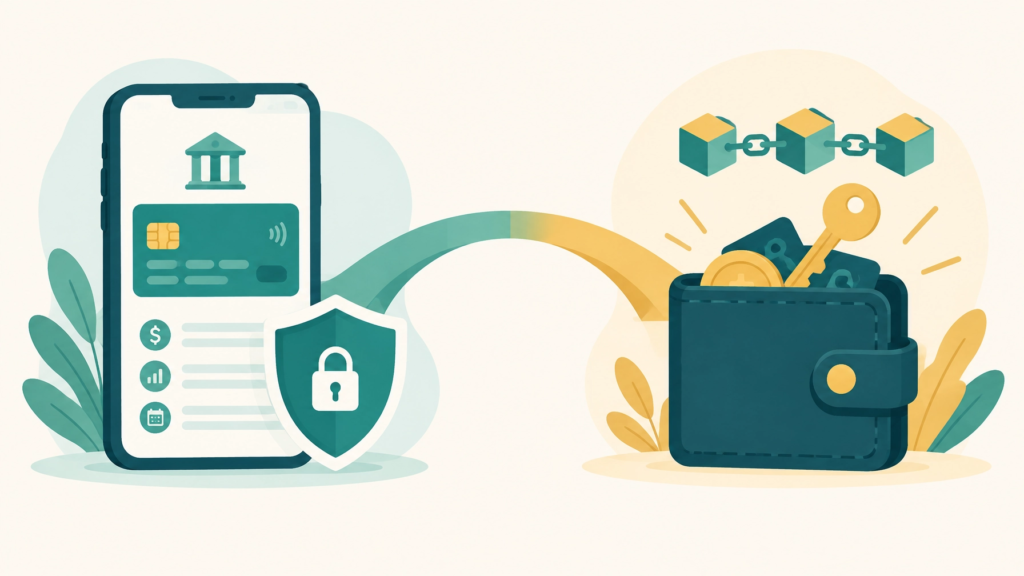

Sending money to another country can be frustrating.
A transfer may pass through several banks, take multiple business days, and cost more than expected once fees and exchange-rate markups are included.
Stablecoins offer another way to move digital value across borders. They can operate around the clock and may reduce some of the steps involved in traditional remittances. However, they are not risk-free, and they are not automatically cheaper in every country or situation.
This guide explains how cross-border transfers work, where stablecoins fit, and what beginners should check before sending money.
How traditional international money transfers work
When you send money through a traditional bank or remittance service, the process may involve several stages:
- You provide your local currency to a bank or money-transfer company.
- The provider converts the money into another currency.
- One or more intermediary banks help move the funds between countries.
- The receiving bank or local payout service delivers the money to the recipient.
This system can work well, but it may also create delays and extra costs.
Fees can come from several places
A transfer may include:
- A sending fee
- A receiving fee
- Currency-conversion costs
- Exchange-rate markups
- Intermediary bank charges
- Cash-pickup or payout fees
The advertised fee is not always the full cost. Sometimes the biggest expense is hidden in the exchange rate. The recipient may receive less because the provider uses a less favorable rate than the market rate.
The World Bank’s Remittance Prices Worldwide database tracks the cost of sending money across different corridors. Its data shows that average costs can remain significant, especially for smaller transfers.
Banking hours can slow things down
Traditional transfers often depend on business hours, bank cut-off times, weekends, and public holidays. A transfer sent late on Friday may not begin processing until Monday. If another country has a holiday, the delay may be longer.
Some modern digital remittance services are faster than traditional bank wires. Still, the final delivery time depends on the sending method, the receiving institution, compliance checks, and the destination country.
How stablecoin transfers work
A stablecoin is a digital asset designed to track the value of another asset, often the U.S. dollar. You can think of it as a digital representation of dollar-linked value that moves on a blockchain.
A cross-border stablecoin transfer usually has three parts:
- Buy or receive the stablecoin. You may exchange local currency for a stablecoin through an exchange, wallet, or payment service.
- Send it to the recipient. The stablecoin moves from one digital wallet to another over a blockchain network.
- Hold, spend, or convert it. The recipient may keep the stablecoin, use it where accepted, or convert it into local currency.
The blockchain transfer itself can happen at any time, including nights, weekends, and holidays. It does not require a chain of correspondent banks to move the token from one wallet to another.

That does not mean every part of the transaction is instant.
Buying the stablecoin and converting it into local currency may still involve identity checks, bank processing, service limits, or local payment networks.
For a helpful introduction, read our guide on how to use stablecoins.
Why people consider stablecoins for remittances
Stablecoins may be useful for people who need to move money internationally, including families supporting relatives, freelancers receiving global payments, and small businesses paying contractors.
Potential advantages include:
24/7 availability
Blockchain networks generally operate continuously. A recipient may be able to receive a stablecoin transfer outside normal banking hours.
Fewer intermediary banks
The on-chain portion of the transfer can move directly between wallets. This may reduce the number of traditional intermediaries involved in settlement.
Transparent network fees
Blockchain networks usually display a transaction fee before the transfer is confirmed. The fee depends on the network and its activity level. Some networks are inexpensive, while others can become costly during periods of congestion.
Greater control over digital funds
With a self-custody wallet, you control the keys needed to access your assets. This can support the broader idea of being your own bank and reducing dependence on centralized financial systems.
That control also creates responsibility. If you send funds to the wrong address or lose your recovery phrase, there may be no bank that can reverse the payment or restore access.
Stablecoins are not automatically cheaper
A common mistake is to compare only the blockchain fee. The total cost can include:
- The fee to buy the stablecoin
- The exchange-rate spread
- The blockchain network fee
- The fee to sell or convert the stablecoin
- The cost of sending funds to a bank account or collecting cash
- Local taxes or regulatory charges
In some corridors, stablecoins may reduce costs. In others, a traditional digital remittance provider may be just as affordable or even cheaper.
The most important comparison is the all-in cost. Before sending money, compare how much the recipient will actually receive after every fee and exchange-rate adjustment.
Risks to understand before sending money
Stablecoins can reduce some types of friction, but they introduce risks that should not be ignored.
Stablecoin depeg risk
A stablecoin may trade above or below its intended value. It is designed to remain stable, but that is not a guarantee. Issuer problems, liquidity issues, market stress, or loss of confidence can affect its price.
Volatility of other digital assets
Bitcoin, Ether, and other non-stable digital assets can change value quickly. They may not be appropriate for a payment that needs a predictable amount. A stablecoin may reduce some price volatility, but it does not remove all digital-asset risk.
Smart contract and network risk
Blockchain systems rely on software. A technical issue, network outage, congestion, or smart contract weakness could delay a transfer or create a loss.
Wallet and custody risk
A custodial service may freeze an account, pause withdrawals, or experience a security incident. A self-custody wallet gives you more direct control but requires careful protection of your private keys and recovery phrase.
Regulatory differences
Rules for stablecoins, money transfers, taxes, and digital assets vary by country. Some jurisdictions may require identity checks, reporting, licensing, or additional fees. Always check the rules that apply where you live and where the recipient lives.
Our guide to self-custody and custodial stablecoin wallets explains the main tradeoffs.
Beginner checklist for a cross-border stablecoin transfer
Before sending your first transfer:
- Choose a stablecoin that is available and permitted in your location.
- Review who issues it and how it is designed to maintain its value.
- Confirm that both wallets support the same stablecoin and blockchain network.
- Verify the recipient’s wallet address through a trusted channel.
- Check the first and last characters of the address before sending.
- Review the network fee and all buying or cash-out fees.
- Send a small test transfer when practical.
- Wait for confirmation before sending the full amount.
- Keep records of the purchase, transfer, fees, and conversion.
- Understand how the recipient will use or convert the stablecoin.
- Check local tax, reporting, and money-transfer rules.
- Never share a private key or wallet recovery phrase.
A decentralized banking platform such as WeFi may be one option people explore when learning about digital wallets and on-chain money movement. It is one option among many, so review the platform’s terms, fees, availability, and risks before deciding whether it fits your needs.
Frequently asked questions
Are stablecoin transfers instant?
They can be confirmed within seconds or minutes, depending on the blockchain network. However, buying the stablecoin or converting it into local currency may take longer because of provider processing, compliance reviews, bank hours, or local payout systems.
What fees should I expect?
Possible costs include purchase fees, exchange-rate spreads, blockchain network fees, withdrawal fees, and local cash-out charges. Review the complete cost before confirming the transfer rather than looking only at the network fee.
What happens if the stablecoin price drops?
If the stablecoin loses its intended value, the recipient may receive less value than expected. A stablecoin is designed to track a reference asset, but it is not guaranteed to remain exactly equal to that asset.
Do I need to report a stablecoin transfer?
It depends on your country, the purpose of the transfer, the amount, and whether you bought, sold, converted, or earned the asset. Keep complete records and ask a qualified local tax professional when necessary.
Is sending stablecoins safe?
It can be done carefully, but no payment method is completely risk-free. Verify the address and network, use security protections, begin with a small amount, and avoid anyone promising guaranteed returns or urgent profits.
Final thoughts
Stablecoins can provide a new way to send dollar-linked digital value across borders without relying entirely on traditional banking hours or correspondent banks. For some people, the combination of global access, transparent blockchain fees, and 24/7 transfers may be useful.
But the best option depends on the corridor, provider, exchange rate, regulations, and how the recipient plans to use the funds. Always compare the full cost and understand the risks before sending money.
This article is for educational purposes only and is not financial advice. WeFi is not a bank. There is no FDIC insurance for digital assets held through WeFi or other non-bank platforms. Digital assets carry risk, including loss of value, depeg risk, custody risk, technical risk, fraud, and regulatory risk. There are no guarantees of safety, performance, savings, or outcomes.
Ready to Learn More? Join Our Free Educational Zoom Calls!
Mark Your Calendar! Every Monday and Thursday at 8:00 PM ET / 7:00 PM CT.
Learn directly how to navigate the world of digital finance and decentralized banking in a simple, no-hype environment.
Call to action (safe next step)
Sign up for your free decentralized account. Visit Our Website: bridgetoweb3.com.