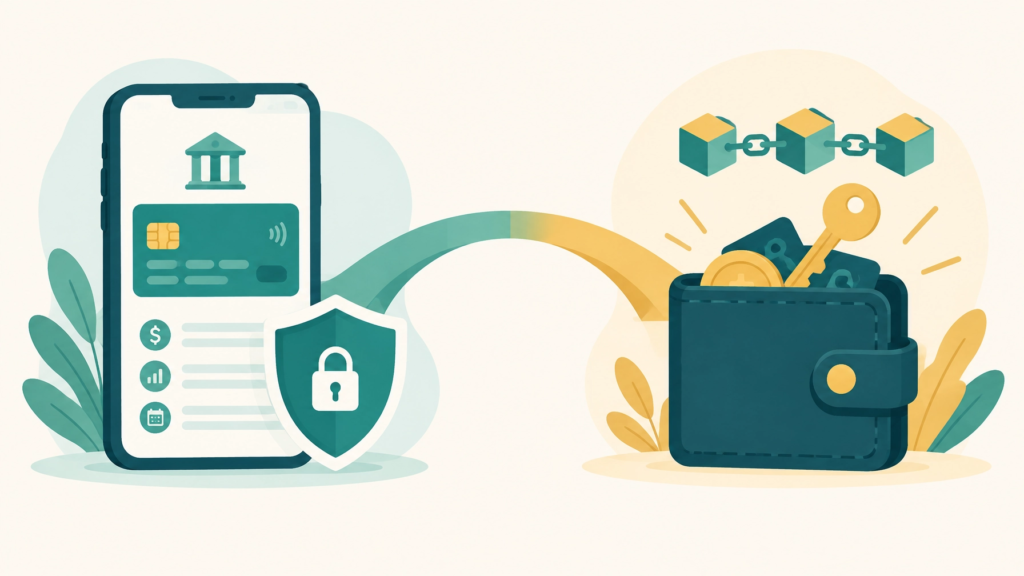

A neobank and a “deobank” can both look like an app on your phone. But the experience on screen doesn’t tell you who holds the money, who can access it, or what happens if something goes wrong.
Understanding that difference can help you decide which tools fit your needs, and what questions to ask before moving funds. One important note up front: “neobank” is a common industry term, while “deobank” has no single, standard legal definition. The label alone doesn’t tell you how a service works.
What is a neobank?
A neobank is a digital-first financial service, usually accessed through a mobile app or website. It may offer features such as payments, account balances, transfers, and budgeting tools without a branch network.
But “neobank” doesn’t always mean the company itself is a bank. Some digital providers are licensed banks; others are financial technology companies that work with a partner bank or another regulated provider. The Bank of England explains that digital banking services can be offered through different business models.
That makes a practical question more useful than the label: Which legal entity holds the funds, and what protections apply to this specific account?
What is a deobank?
“Deobank” is often used to describe a banking-like service built around blockchain networks, digital wallets, and software called smart contracts. Because the word isn’t a standardized legal category, two services using it may work quite differently.
A service might offer a self-custody wallet, where you control the private keys used to access assets. Another might involve a company, custodian, payment provider, or smart contract holding or managing assets. Some products combine several of these arrangements.
So don’t assume that a deobank service is fully decentralized, or that you control every asset directly, just because the name suggests it. Check the specific product terms and how it works. The European Central Bank’s overview of decentralized finance also notes that decentralized systems can be difficult to assess when there is no clear central operator.
Neobank vs. deobank: the key differences
| Question | Neobank | Deobank or decentralized finance service |
|---|---|---|
| Who provides the service? | A digital bank or fintech, sometimes with a partner bank | A wallet provider, protocol, company, or mix of providers |
| Who controls access? | Typically the provider controls the account and can apply account rules | Depends on the setup: you may control private keys, or assets may be held or managed by a service or smart contract |
| What protections apply? | Depends on the provider, account, country, and legal structure | Don’t assume bank deposit protection applies; check the terms and relevant laws |
| How are problems handled? | There may be customer support and a formal dispute process | Support and recovery options vary; some blockchain transactions may be difficult or impossible to reverse |
| What are the main risks? | Provider, partner-bank, account-access, fraud, and service-outage risks | Key loss, scams, software bugs, volatile assets, and limited recovery options |
The table gives a general picture, not a guarantee about every provider. Rules differ by country and product.
The bigger distinction: convenience or control?
A neobank may feel familiar: one company manages the account experience, and you can contact its support team if you have a problem. That can be convenient. At the same time, account access and transactions may depend on the provider’s systems, policies, and partners.
Self-custody can give you more direct control over digital assets. You may be able to access a wallet without relying on one bank to process every transaction. For people who want more choice beyond centralized financial providers, that can be meaningful.
But control also means responsibility. If you lose access to a self-custody wallet or share your recovery details with a scammer, there may be no customer service team that can restore your assets. And a wallet connected to a decentralized protocol doesn’t automatically make every feature decentralized.
A useful way to think about it is: What can you control yourself, and what still depends on another person, company, or piece of software?
Don’t assume funds are insured
In the United States, FDIC insurance applies to eligible deposits held at an FDIC-insured bank, subject to rules and limits. It does not automatically cover funds held by a nonbank app if that company fails. The Consumer Financial Protection Bureau explains that the protection for payment-app balances can depend on how funds are held and other conditions.
Digital assets and balances connected to blockchain services should not be treated as insured bank deposits unless you’ve verified that a specific protection applies. Read the provider’s disclosures, identify the legal entity involved, and ask what happens if the provider, custodian, or platform becomes unavailable.
A beginner checklist before choosing
Before opening an account or connecting a wallet, take a moment to check:
- Who operates the service? Find the legal company name, not just the brand.
- Who holds or controls the assets? Look for clear information about custody and private keys.
- What protections apply? Verify insurance, safeguarding, or other protections for the exact product.
- What can go wrong? Check how the provider handles account freezes, fraud, outages, and complaints.
- Can you recover access? Understand the recovery process, and what happens if you lose your wallet credentials.
- Do you understand the fees and terms? Read the details before transferring money or digital assets.
- Have you started small? If you decide to try a new tool, learn its features before committing funds you can’t afford to lose.
For a gentle introduction to the underlying technology, explore our simple guide to Web3.
FAQ
Is a neobank the same as a bank?
Not always. Some neobanks are licensed banks; others are fintech companies that partner with a bank or another provider. Check which entity actually provides your account.
Is a deobank always decentralized?
No. “Deobank” isn’t a standardized legal label. A service may include centralized companies, custodians, or other intermediaries. Review how each feature works.
Which one is safer?
There’s no universal answer. A regulated bank account and a self-custody wallet have different protections and risks. Compare the specific provider, product, and responsibilities, not just the name.
Can digital assets in a deobank be FDIC-insured?
Don’t assume so. FDIC insurance generally applies to eligible deposits at insured banks, not digital assets simply because they appear in an app.
A thoughtful next step
Neobanks and deobank-style services reflect different ways to access financial tools. One may prioritize a familiar provider-managed experience; another may offer more direct control over certain digital assets. Neither label guarantees safety, privacy, or independence. The details matter.
Take time to understand custody, account protections, and recovery options before making a decision. Learning how these systems work can help you make choices that fit your goals, and maintain greater control over how you use your money.
Disclaimer: This article is for educational purposes only and is not financial advice. WeFi is not a bank and does not offer FDIC insurance. Digital assets carry risk, including possible loss of value or access. No outcomes are guaranteed.
Ready to Learn More? Join Our Free Educational Zoom Calls!
Mark Your Calendar! Every Monday and Thursday at 8:00 PM ET / 7:00 PM CT, join our free educational Zoom call to learn about digital finance and decentralized banking.
A Safe Next Step
If you’d like to explore further, start by learning at your own pace and reviewing the terms of any service before using it.
Sign up for your free decentralized account
Visit Our Website: bridgetoweb3.com