For generations, managing money meant one thing: walking into a brick-and-mortar bank, opening a checking account, and trusting traditional financial institutions to handle your savings, payments, and transfers. Today, however, we are witnessing a massive shift in how the world thinks about currency. With the rise of digital finance, decentralized banking, and blockchain technology, terms like "stablecoins" are entering everyday conversations.
If you have ever wondered how stablecoins stack up against your regular checking or savings account, and why this comparison matters for your financial future, you are in the right place. Let's break down these concepts in plain, simple English, exploring how you can take control of your financial journey.
Understanding Traditional Banking
Traditional banking is the system most of us grew up with. When you deposit money into a conventional bank, that institution holds your funds, tracks your balance on private ledgers, and uses established payment networks like ACH, wire transfers, and credit card rails to move money.
While traditional banks offer familiar services, they also come with distinct limitations:
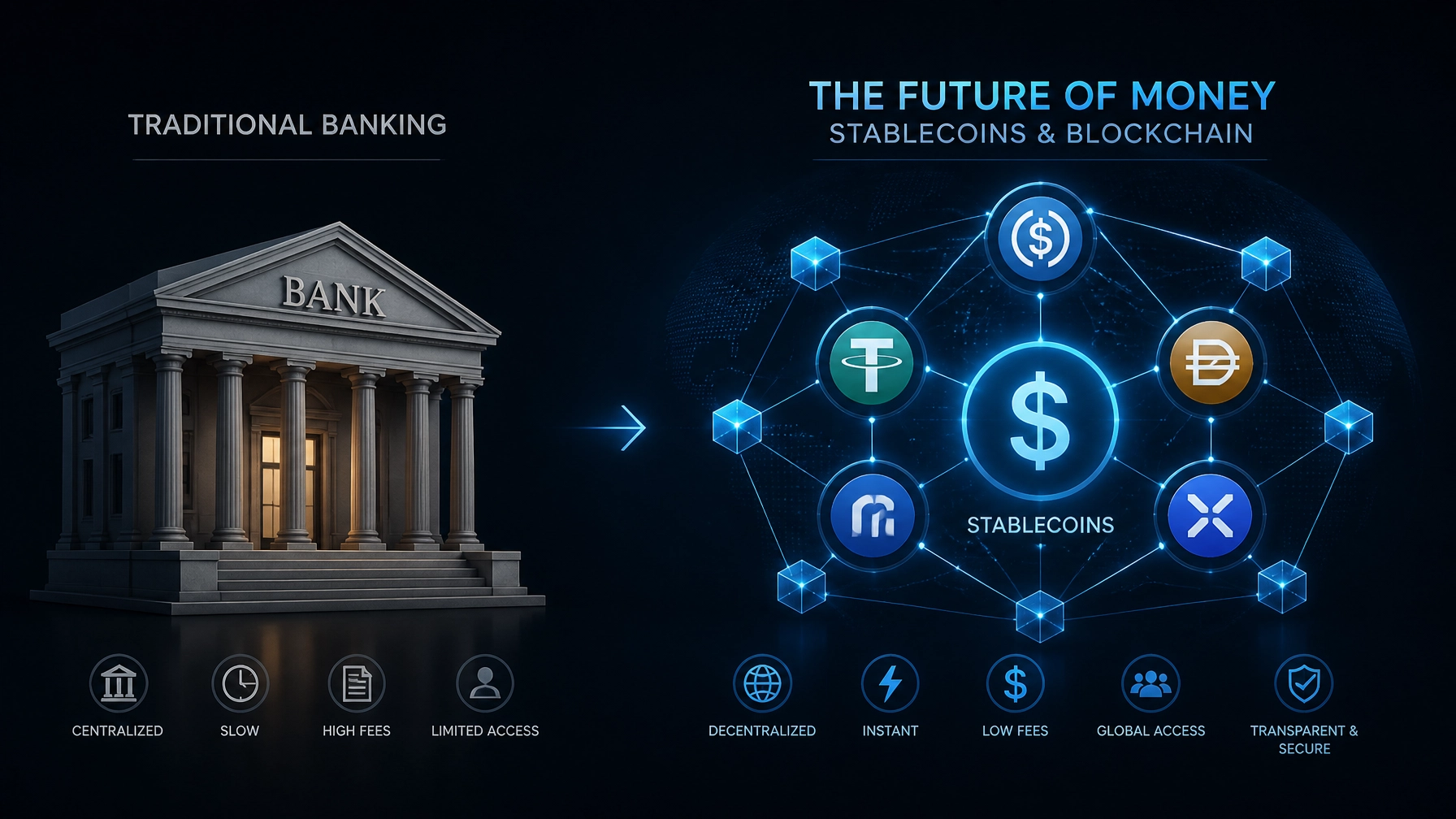
- Operating Hours & Delays: Traditional wire transfers and ACH payments often take anywhere from one to five business days, especially across borders. Transactions usually pause over weekends and bank holidays.
- Geographic Restrictions: Moving money internationally through traditional channels often involves steep fees, unfavorable exchange rates, and strict paperwork.
- Centralized Control: Your account access, transaction approvals, and limits are entirely governed by the policies of a centralized institution.
To explore more about how modern financial models compare, check out our guide on neobank vs deobanking.
What Are Stablecoins?

Stablecoins are a specific type of digital asset designed to maintain a steady value, usually pegged 1:1 to a major fiat currency like the US dollar. Unlike volatile cryptocurrencies, a stablecoin aims to remain worth roughly one dollar at all times by being backed by reserves such as cash equivalents or short-term government securities.
Instead of relying on bank ledgers and business hours, stablecoins operate on public blockchains. This means they can be sent anywhere in the world, 24 hours a day, 365 days a year, settling in mere seconds for a fraction of a cent in network fees.
As we discuss in our deep dive on stablecoins vs traditional banking for daily money, understanding these digital rails is an essential step toward financial independence.
Key Differences at a Glance
When comparing traditional banking and stablecoins, several fundamental differences stand out:
- Speed & Settlement: Traditional transfers batch process during banking hours. Stablecoin transactions settle instantly on-chain, 24/7/365.
- Access & Inclusion: Traditional bank accounts require extensive documentation, minimum balances, and local residency approvals. Stablecoins require only an internet connection and a digital wallet, opening doors for the unbanked and underbanked worldwide.
- Transparency: Blockchain transactions are publicly verifiable on a distributed ledger, whereas traditional bank internal ledgers are closed and opaque.
- Insurance & Backing: Traditional bank deposits in many regions benefit from government-backed insurance (such as FDIC insurance up to $250,000). Stablecoins operate independently of government deposit insurance schemes.
For a foundational look at how decentralized finance and stablecoins intersect, explore why consider WeFi deobanking.
Empowering Yourself Through Financial Education

The core mission of modern financial education is not to tell you where to put every dollar, but to empower you with choices. Moving toward concepts like "being your own bank" means understanding how to manage your assets with global reach and personal sovereignty, stepping away from total reliance on legacy systems.
Whether you are looking into what is a deobank or exploring how to use stablecoins, education is your best tool for navigating this evolution safely.
Practical Checklist: Stablecoins vs. Traditional Banking

Before making any decisions about how you manage your funds, review this practical comparison checklist:
- Do you need physical branch access? Traditional banks provide local brick-and-mortar branches, whereas digital finance is entirely online.
- Are you sending money internationally? Stablecoins offer near-instant, low-cost global transfers without traditional wire fees.
- Do you value government deposit insurance? Traditional bank accounts feature FDIC or equivalent protections, while digital assets carry different risk profiles.
- Do you want 24/7 control? Blockchain-based assets operate around the clock without bank holidays or transfer freezes.
- Are you comfortable managing your own security? Self-custody requires safeguarding digital keys and passwords carefully.
Important Disclaimers
- Educational Purposes Only: The information provided in this article is for general educational and informational purposes only and does not constitute professional financial, legal, or investment advice.
- Not a Bank / No FDIC Insurance: Platforms like WeFi are technology and educational providers, not traditional commercial banks. Digital assets and stablecoins held outside of traditional banking systems are not covered by FDIC or SIPC deposit insurance.
- Risk Awareness: Digital finance, blockchain technology, and stablecoins involve inherent risks, including technological vulnerabilities, regulatory shifts, and potential loss of value. There are no guarantees in financial markets. Always do your own research before engaging with new financial technologies.
Frequently Asked Questions (FAQ)
Q: Are stablecoins the same thing as Bitcoin?
A: No. While both use blockchain technology, Bitcoin's price fluctuates based on market demand. Stablecoins are pegged to a stable asset (like the US dollar) to maintain a consistent value.
Q: Can I earn interest on stablecoins?
A: Some decentralized finance platforms and protocols offer yield opportunities, but unlike traditional savings accounts managed by banks, these yields are generated through decentralized markets and carry different risk profiles.
Q: Do I need a traditional bank account to use stablecoins?
A: While many people acquire stablecoins initially using fiat currency from a bank account or exchange, the stablecoins themselves live on a blockchain and can be held and transferred without a traditional bank account.
Ready to Learn More? Join Our Free Educational Zoom Calls!
Mark Your Calendar! Every Monday and Thursday at 8:00 PM ET / 7:00 PM CT.
Learn directly how to navigate the world of digital finance and decentralized banking in a simple, no-hype environment.
Call to action (safe next step)
Sign up for your free decentralized account. Visit Our Website: bridgetoweb3.com.