SEO title: Alternative Financial Systems Explained for Beginners
Meta description: Learn how DeFi, stablecoins, digital wallets, and peer-to-peer payments differ from traditional banking, including benefits, risks, and beginner safety tips.
Imagine sending money to someone in another country without waiting several business days, visiting a bank branch, or relying on a chain of intermediaries. Imagine also having more direct control over how your digital assets are stored and moved.
That is the idea behind alternative financial systems.
These systems do not necessarily replace traditional banks. Instead, they offer different ways to store, send, and manage value using digital technology. Some use blockchain networks, while others use online platforms that connect people directly.
For beginners, the topic can sound complicated. In reality, the main ideas are easier to understand when broken down into four areas:
- Decentralized finance, often called DeFi
- Stablecoins
- Digital wallets
- Peer-to-peer payments
This guide explains how they work, how they differ from traditional banking, and what to consider before using them.
Important disclaimer: This article is for educational purposes only and is not financial, legal, or tax advice. Digital assets and blockchain services carry risk. There are no guarantees, and you should do your own research and consider speaking with a qualified professional before making financial decisions.
What Are Alternative Financial Systems?
Traditional banking usually depends on centralized institutions. A bank holds customer deposits, processes payments, maintains account records, and decides which services customers can access.
Alternative financial systems use different structures. They may allow people to interact through a public blockchain, a digital wallet, or a technology platform rather than relying only on a bank.
The goal is often to make financial services more:
- Accessible
- Global
- Transparent
- Available around the clock
- Directly controlled by the user
However, greater control also comes with greater responsibility. If you use a self-custody wallet, for example, you may be responsible for protecting your access keys. Unlike a traditional bank account, there may not be a simple password reset if those keys are lost.
Alternative finance is best understood as another set of tools: not an automatic replacement for every traditional financial service.
Four Important Parts of Alternative Finance
1. Decentralized Finance, or DeFi
Decentralized finance refers to financial applications that operate on blockchain networks. Instead of a bank or broker managing every transaction, DeFi services use computer programs called smart contracts.
A smart contract is software that follows a set of rules. For example, it may release a payment when certain conditions are met. The rules are recorded on a blockchain, where transaction activity can often be viewed publicly.
According to Ethereum’s educational overview of DeFi, decentralized applications can support activities such as sending money, exchanging tokens, lending, borrowing, and accessing stable-value digital assets.
In simple terms, DeFi aims to make financial services available through the internet without depending entirely on a central institution.
That can create more choice and global access. It can also create new risks, including software bugs, scams, network fees, and irreversible transactions.
2. Stablecoins
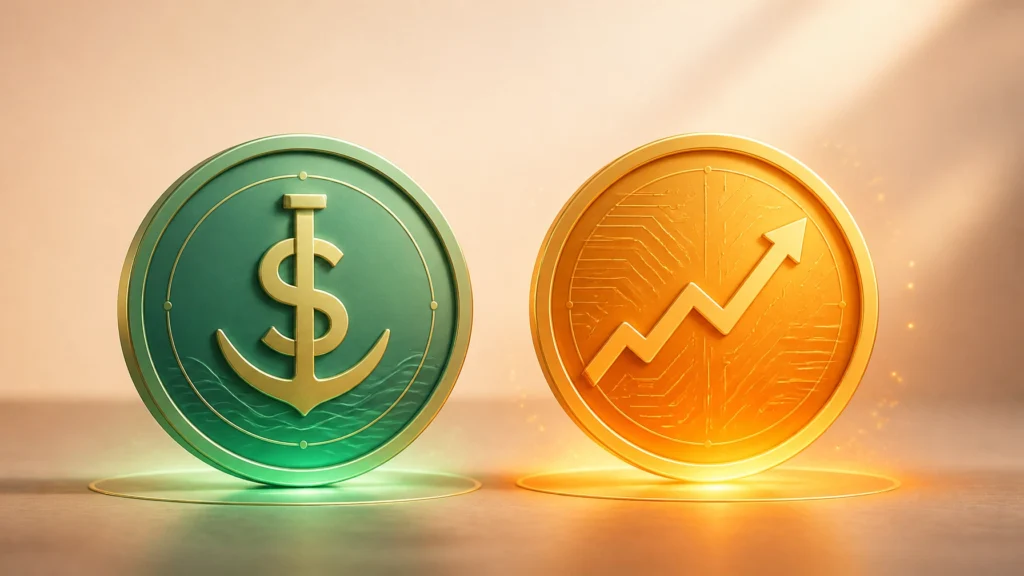
Stablecoins are digital assets designed to maintain a relatively stable value compared with a reference asset, usually a national currency such as the U.S. dollar.
For example, a stablecoin may be designed to track the value of one U.S. dollar. People may use stablecoins to move value across a blockchain without dealing with the same level of price movement associated with assets such as Bitcoin or Ether.
Stablecoins can be used for:
- Sending money between digital wallets
- Making international payments
- Moving funds between blockchain applications
- Representing dollar-like value inside DeFi services
The word “stable” does not mean risk-free. A stablecoin’s value depends on how it is designed, what supports it, how reserves are managed, and how the issuer operates. A stablecoin can lose its intended value, face restrictions, or become difficult to redeem.
It is important to understand the specific asset rather than assuming every stablecoin works the same way.
3. Digital Wallets
A digital wallet is a tool for storing and managing access to digital assets. In blockchain systems, a wallet generally does not hold coins in the same way a physical wallet holds cash. Instead, it stores the keys that allow you to authorize transactions connected to assets recorded on a blockchain.
There are two broad approaches:
- Custodial wallets: A company manages the keys for you. This can feel familiar, but you depend on that company to provide access.
- Self-custody wallets: You control the keys yourself. This gives you more direct control, but you are also responsible for protecting your recovery phrase and devices.
Self-custody is closely connected to the idea of being your own bank. You may have more independence from a centralized institution, but you must take security seriously.
Never share a recovery phrase or private key. Be careful with unexpected messages, links, and requests to “verify” your wallet. A legitimate support representative should not need your recovery phrase.

4. Peer-to-Peer Payments
Peer-to-peer, or P2P, means one person sends value directly to another person.
With a blockchain-based payment, the sender can transfer digital assets from one wallet address to another. The blockchain records the transaction rather than a bank updating two internal customer accounts.
P2P payments may be useful for:
- Sending money across borders
- Paying remote workers or international contractors
- Supporting family members in another country
- Moving value outside normal banking hours
The recipient still needs a compatible wallet or service, and both people must use the correct network and address. A mistake can be difficult or impossible to reverse.
It is also important to distinguish blockchain P2P payments from popular payment apps. Many payment apps are centralized companies that maintain their own internal records. They may be convenient, but they are not the same as using a self-custody wallet on a public blockchain.
How Alternative Finance Differs From Traditional Banking
| Topic | Traditional banking | Alternative financial systems |
|---|---|---|
| Account control | The bank manages the account and payment system | The user may control assets through a wallet |
| Access | Often depends on location, identity checks, and account approval | Some blockchain services can be accessed globally with an internet connection |
| Operating hours | Some transfers follow business hours and cutoff times | Blockchain networks generally operate 24/7 |
| Transparency | Bank records and internal systems are usually private | Many blockchain transactions are publicly viewable |
| Customer support | Banks may help reverse or investigate certain transactions | Blockchain payments are often final |
| Protection | Some bank accounts may have legal protections or deposit insurance | Protections vary and may be limited |
| Responsibility | The bank handles much of the security process | Self-custody users handle key and wallet security |
| Fees | Fees may include account, wire, overdraft, or exchange charges | Network and service fees can change based on demand |
Neither system is perfect. Traditional banking is familiar and may offer consumer protections that blockchain services do not. Alternative systems can offer speed, global access, and more direct control, but they require careful use.
A hybrid approach may make sense for some people. You do not have to close a traditional bank account simply because you are learning about digital finance.
The Main Benefits
Alternative financial systems may offer several potential benefits:
More direct control
With self-custody, you may hold the keys to your digital assets instead of depending entirely on a financial institution. This can support greater independence from centralized banking systems.
Global access
A blockchain network does not operate according to the same national borders as traditional payment systems. This may make it easier to send or receive value internationally, although local laws, platform rules, and conversion services still matter.
Around-the-clock availability
Blockchain networks generally operate continuously. A transaction can be submitted on a weekend or holiday, although confirmation time and fees may vary.
More visible transaction records
Public blockchains allow users to view many transactions and wallet balances. This does not make every system automatically trustworthy, but it can provide a level of visibility that traditional banking customers may not have.
The Risks Beginners Should Understand
Alternative finance also comes with serious risks.
Digital asset prices can change quickly. Even assets designed to be stable can lose value or become difficult to redeem.
Transactions may be irreversible. Sending funds to the wrong address or network may result in permanent loss.
Scams are common. Be cautious of guaranteed returns, urgent messages, fake support accounts, and offers that pressure you to act quickly.
Smart contracts can fail. DeFi applications rely on software. Bugs, design problems, or attacks can cause losses.
Fees can change. Network congestion may increase transaction costs, especially during periods of heavy activity.
Regulations vary. Tax rules, reporting requirements, and access to services depend on where you live.
Self-custody requires preparation. Losing a recovery phrase may mean losing access permanently. A wallet can give you more control, but it does not remove responsibility.
WeFi is one example of a project people may encounter while learning about decentralized financial tools. However, WeFi is not a bank and does not provide FDIC insurance. Using a platform or digital wallet does not eliminate asset, technology, custody, counterparty, or regulatory risk. No platform can guarantee a particular outcome.
A Practical Beginner Checklist
Before exploring an alternative financial system, ask yourself:
- Do I understand what asset I am using?
- Do I know whether the wallet is custodial or self-custody?
- Have I confirmed the correct network and wallet address?
- Have I researched the company, protocol, or issuer?
- Do I understand the fees before approving a transaction?
- Have I learned how the stablecoin is designed to maintain its value?
- Am I using only an amount I can afford to lose?
- Have I secured my recovery phrase offline?
- Have I avoided sharing passwords, private keys, or recovery phrases?
- Do I understand the local tax and legal requirements?
- Do I have a backup plan if the service becomes unavailable?
- Am I making a decision based on education rather than pressure or hype?
Start with learning. If you decide to test a tool, consider using a small amount and complete a simple transaction before attempting anything more advanced.
For additional background, you can explore BridgeToWeb3’s educational article on what a Deobank is or read its comparison of neobanking and decentralized banking.
Frequently Asked Questions
Are alternative financial systems the same as cryptocurrency?
No. Cryptocurrency is one part of the broader digital finance ecosystem. Alternative financial systems can also include digital wallets, stablecoins, blockchain-based applications, and peer-to-peer payment tools.
Are stablecoins completely safe?
No. Stablecoins are designed to reduce price volatility, but they still carry risks. Their value can be affected by reserves, issuer decisions, market conditions, regulation, and technical problems.
Can DeFi replace my bank?
DeFi may provide alternatives for certain activities, such as exchanging digital assets or sending payments. It does not automatically replace every service offered by a bank, including cash access, government-backed protections, lending support, and customer assistance.
What happens if I lose my wallet recovery phrase?
In a self-custody system, losing the recovery phrase may mean losing access to the wallet. There may be no bank or company that can reset it for you.
Is WeFi a bank?
No. WeFi is not a bank and offers no FDIC insurance. Digital assets and related services carry risk, and there are no guarantees.
Final Thoughts
Alternative financial systems are changing how people think about ownership, access, and the movement of money.
DeFi can make financial tools more open. Stablecoins can provide a digital way to move dollar-like value. Wallets can give users more direct control. Peer-to-peer payments can make global transfers simpler.
At the same time, these tools require patience, security awareness, and realistic expectations. Financial independence does not mean ignoring risk, laws, or personal responsibilities. It means learning enough to make informed choices and understanding who controls your assets at every step.
The best first move is not rushing into a transaction. It is building your knowledge.
Ready to Learn More? Join Our Free Educational Zoom Calls!
Mark Your Calendar! Every Monday and Thursday at 8:00 PM ET / 7:00 PM CT.
Learn directly how to navigate the world of digital finance and decentralized banking in a simple, no-hype environment.
Call to action (safe next step)
Sign up for your free decentralized account. Visit Our Website: bridgetoweb3.com.