Educational disclaimer: “This article is for educational and informational purposes only and is not financial, investment, legal, or tax advice.”
No guarantees: “We don’t make promises about outcomes. Digital assets and decentralized finance involve risk, including the risk of loss.”
Not a bank / no FDIC: “WeFi DeoBanking is a financial technology/education platform and is not a bank. Digital assets are not FDIC-insured.”
Relationship/name-use transparency note (if applicable): “Bridgetoweb3 may have a partnership/affiliate relationship with WeFi DeoBanking… References to individuals (including Reeve Collins) are for context only and don’t imply endorsement.”
If you’ve been hearing terms like what is DeFi, decentralized banking, or stablecoins, you’re not alone. A lot of people are curious: but also cautious: because the internet can make this space feel confusing and noisy.
This guide is meant to be the opposite of that. We’ll keep it simple, stay education-first, and focus on the basics you actually need to make informed decisions about digital finance for beginners.
Along the way, we’ll also explain where an education and access platform like WeFi DeoBanking can fit: without hype, and with clear boundaries.
What is DeFi (Decentralized Finance)? Plain-English definition
DeFi stands for decentralized finance. In simple terms:
DeFi is a way to use financial tools (like swapping, lending, or borrowing) through software on a blockchain: without needing a traditional bank to run the system.
Instead of a bank approving transactions or holding accounts, DeFi uses:
- Apps (often called dApps)
- Smart contracts (code that follows rules automatically)
- Public blockchains (networks that record transactions)
If you’re searching for decentralized finance basics, the most important shift to understand is this:
DeFi changes “who controls the rails”
Traditional finance usually works like this:
You → Your bank → Payment networks → Another bank → Another person
DeFi aims to work more like:
You → A wallet you control → A protocol (rules in code) → Another wallet
That’s why many people connect DeFi to the idea of financial independence and being able to “be your own bank”: meaning you can hold and move value without needing permission from a centralized institution.
Helpful external reading:
- Bankrate overview: https://www.bankrate.com/investing/what-is-decentralized-finance-defi-crypto/
- Fireblocks DeFi guide: https://www.fireblocks.com/academy/decentralized-finance-guide/

What does “decentralized banking” mean?
“Decentralized banking” isn’t one official technical term, but people often use it to describe bank-like experiences built on DeFi.
Think of familiar activities like:
- storing value
- sending money
- swapping one currency for another
- borrowing against assets
In traditional systems, those actions are managed by banks and payment processors. In decentralized setups, they can be handled by software and networks that are open and global.
The big idea: control and access
A common reason people explore alternative financial systems is wanting:
- access that isn’t limited by borders
- money movement that works 24/7
- more personal control over how assets are stored and transferred
That said, more control also means more responsibility (we’ll cover that in the risk section).
Stablecoins 101: what they are, benefits, and real risks
Educational disclaimer: “This article is for educational and informational purposes only and is not financial, investment, legal, or tax advice.”
No guarantees: “We don’t make promises about outcomes. Digital assets and decentralized finance involve risk, including the risk of loss.”
Not a bank / no FDIC: “WeFi DeoBanking is a financial technology/education platform and is not a bank. Digital assets are not FDIC-insured.”
What is a stablecoin?
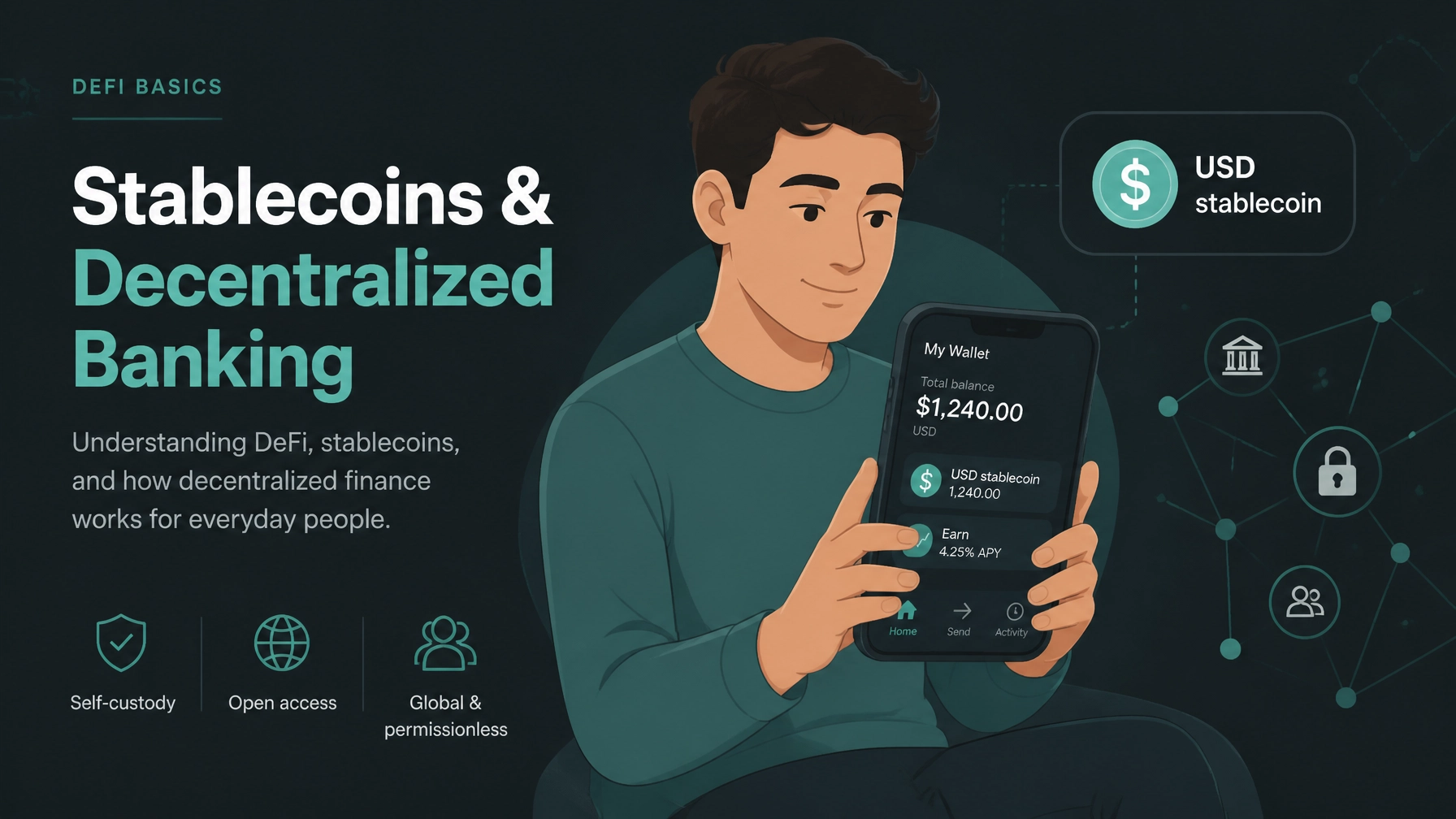
A stablecoin is a type of digital asset designed to hold a steadier value: often by aiming to track a currency like the U.S. dollar.
People often use stablecoins because they can make digital transactions feel more practical than using assets that swing in price more dramatically.
If you’re comparing stablecoin vs traditional banking, you can think of stablecoins as:
- digital value that can move on global networks
- often faster to transfer than traditional rails
- usable in many DeFi apps
Good explainer: Chainlink article on DeFi + stablecoins:
https://chain.link/article/defi-stablecoins-explained
Stablecoin benefits (balanced, not hyped)
When people talk about stablecoin benefits, they often mean:
- Easier digital money management: a steadier unit for budgeting and transferring
- Cross-border movement: sending value internationally without relying on bank hours
- On-chain utility: stablecoins are widely used inside DeFi tools
Stablecoin risks (must-know for beginners)
Stablecoins are not all the same. Risks can include:
- De-pegging risk: a stablecoin may not hold its target value in stress events
- Reserve/custody risk: some stablecoins rely on off-chain reserves and third parties
- Smart contract risk: some stablecoins depend on complex on-chain systems
- Regulatory risk: rules can change, affecting access or use
If you want to explore how to use stablecoins, treat it like learning a new tool:
start small, test transfers, and prioritize understanding over speed.

What is a neobank vs deobank?
This keyword comes up a lot: What is neobank vs deobank? Here’s a beginner-friendly way to separate them.
Neobank (simplified)
A neobank is a modern, app-first financial brand that typically still relies on the traditional banking system behind the scenes (partners, banks, card networks, and local regulations).
“Deobank” (simplified)
A “deobank” concept usually refers to a modern app experience that helps users access decentralized finance tools: often involving:
- stablecoins
- wallets
- on-chain transfers
- decentralized protocols
Important: the experience may look “bank-like,” but it is not the same as a regulated bank account, and protections can differ.
Why modern financial education matters right now
Whether you love or hate the topic, money is becoming more digital. People are already navigating:
- mobile banking
- instant transfers
- digital wallets
- new payment tools
- changing privacy and control expectations
So modern financial education is less about trends: and more about being prepared.
Education helps you:
- understand how digital systems work
- spot scams and fake apps
- avoid shortcuts that cause expensive mistakes
- make choices aligned with your comfort level
This is especially true in DeFi, where self-custody can be empowering, but also unforgiving if you ignore basics.
DeFi safety basics (the non-negotiables)
Here are practical, beginner-friendly fundamentals. If you only remember a few things, remember these.
1) Understand self-custody before moving value
If you use a self-custody wallet, you may be responsible for:
- protecting your device
- securing your seed phrase
- avoiding fake links
If you lose access to your keys/seed phrase, there may be no “password reset.”
2) Watch for phishing, clones, and fake support
Beginners are often targeted by:
- lookalike websites
- fake customer support accounts
- “urgent” messages
Slow down. Verify URLs. Don’t share seed phrases. Ever.
3) Know what you’re interacting with
Before using any DeFi tool, ask:
- What network is this on?
- What protocol is it using?
- Is there public documentation?
- Has it been audited?
- What are the known risks?
A helpful beginner overview on how DeFi lending and staking can work:
https://ilink.dev/blog/how-defi-protocols-work-a-beginners-guide-to-lending-staking-and-yield-farming/

Checklist: how to evaluate a DeFi education + access platform
If you’re deciding where to learn (and possibly access tools), use a clear checklist. This is good Fintech hygiene in general.
Look for clarity, not buzzwords
- Do they explain risks in plain English?
- Do they avoid hype and “too good to be true” claims?
- Do they define basics like wallets, stablecoins, and fees?
Look for transparency
- Do they say what they are and aren’t?
- Do they clearly state “not a bank” when appropriate?
- Do they explain where responsibility sits (user vs platform)?
Look for beginner-friendly learning paths
- glossary and definitions
- short tutorials
- security basics
- step-by-step onboarding that encourages testing with small amounts
Look for good online safety practices
- clear guidance about scams
- reminders that seed phrases should never be shared
- official links and verified channels
Where WeFi DeoBanking fits (soft and transparent)
WeFi DeoBanking positions itself as a financial technology/education platform that helps people understand and navigate decentralized banking and stablecoin-based systems.
That means the “Why WeFi?” answer, in an education-first sense, is mainly:
- a place to learn decentralized banking concepts in simpler language
- a structured introduction to digital money management tools and safety habits
- a beginner-friendly bridge into alternative financial systems, without pretending risks don’t exist
Important note: WeFi DeoBanking is not a bank. Digital assets are not FDIC-insured.
Internal links (available today)
At the time of writing, the site’s public pages are limited. Here are the real links currently available:
- Home: https://wefideobanking.com/
- Blog landing: https://wefideobanking.com/
- Sample post (WordPress default): https://wefideobanking.com/hello-world/
(As the website expands, this article can be updated with links to a glossary, security page, and beginner course hub.)
Who this is for (and who should pause)
This is for you if you:
- want a plain-English answer to what is DeFi
- care about access and portability of value across borders
- want to learn about stablecoins without being sold a dream
- are willing to take learning and security seriously
You should pause if you:
- need guaranteed outcomes or certainty (DeFi doesn’t offer that)
- are uncomfortable with self-custody responsibility
- are under pressure to move money quickly
- don’t have time to learn the basics first
A good rule: if you feel rushed, stop and reset. Rushed decisions are where most mistakes happen.
A simple “getting started” learning path (no hype)
If your goal is to understand how to use stablecoins and get comfortable with the space:
- Learn key words: wallet, seed phrase, stablecoin, network fee
- Understand custody: who controls access: me or a third party?
- Practice safely: small test transfers, double-check addresses
- Track risks: stablecoin type, platform transparency, security basics
- Only then explore more advanced DeFi tools (slowly)
Call to action (safe, education-first)
If you want a calmer, beginner-friendly way to approach decentralized banking, start with learning: not leaping.
- Visit WeFi DeoBanking and explore the blog: https://wefideobanking.com/
- Make your next step a simple one: build a personal checklist for wallets, stablecoins, and security basics before using any DeFi app.
Educational disclaimer (repeat): “This article is for educational and informational purposes only and is not financial, investment, legal, or tax advice.”
No guarantees (repeat): “We don’t make promises about outcomes. Digital assets and decentralized finance involve risk, including the risk of loss.”
Sources (for continued learning)
- Bankrate: What is DeFi? https://www.bankrate.com/investing/what-is-decentralized-finance-defi-crypto/
- Fireblocks Academy: DeFi guide https://www.fireblocks.com/academy/decentralized-finance-guide/
- Chainlink: DeFi and stablecoins explained https://chain.link/article/defi-stablecoins-explained
- Beginner guide to DeFi lending/staking concepts https://ilink.dev/blog/how-defi-protocols-work-a-beginners-guide-to-lending-staking-and-yield-farming/
- N26 explainer: What is DeFi? https://n26.com/en-eu/blog/what-is-defi