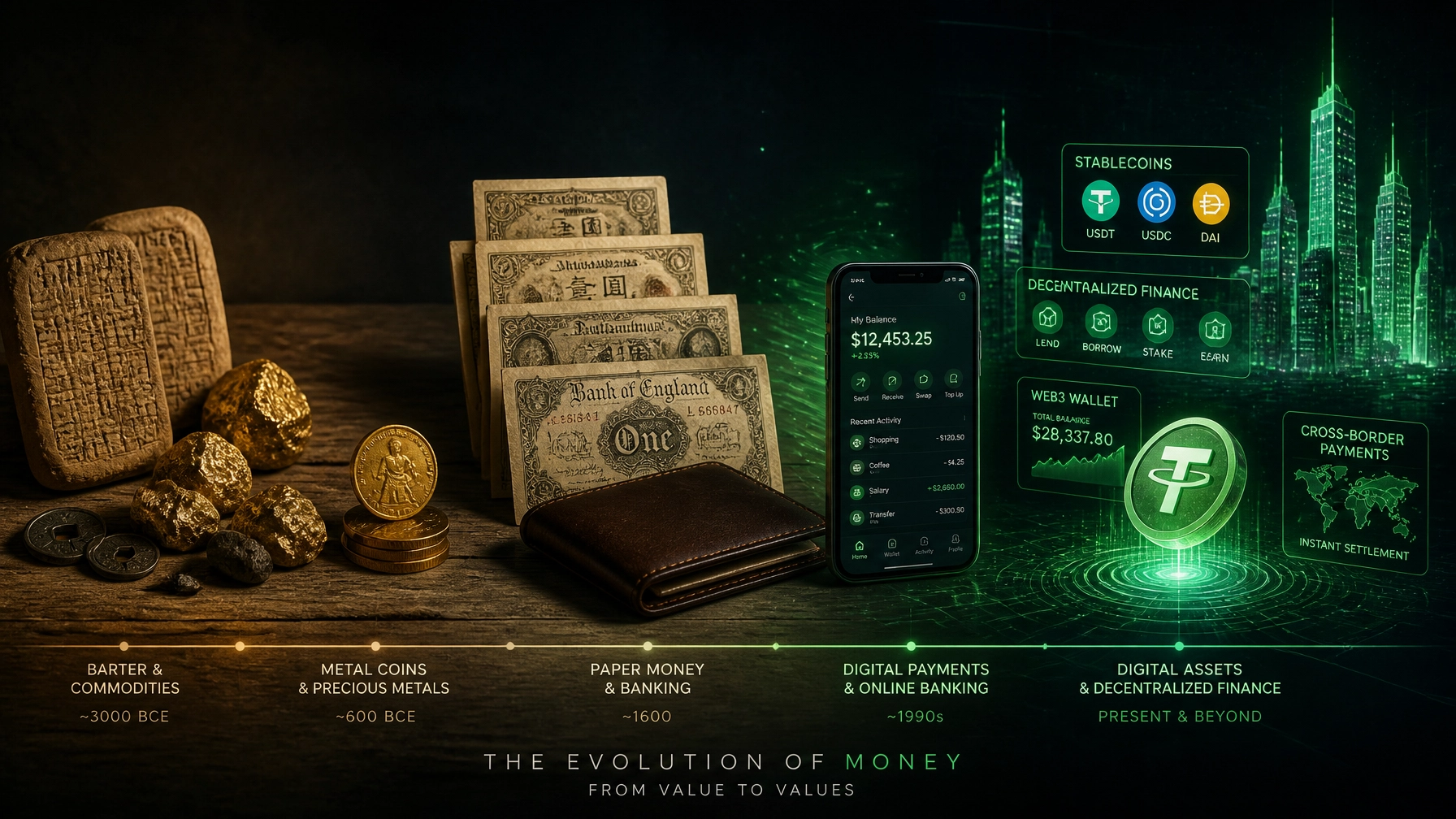
Have you ever stopped to look at a dollar bill or the numbers in your banking app and wondered, "Wait, why does this actually have value?"
Most of us use money every single day without a second thought. We swipe cards, tap phones, and occasionally hand over a few crumpled bills. But the "money" we use today is just the latest chapter in a story that started thousands of years ago.
Understanding the history of money isn’t just a history lesson: it’s the key to understanding why the future of money is moving toward decentralized banking and stablecoins.
Let’s take a trip back in time to see how we got here and why the way we move money is about to change forever.
1. The Barter System: The "Double Coincidence" Headache
Before there were coins or apps, there was barter. If you had a basket of apples and you needed a new pair of shoes, you had to find a shoemaker who happened to be hungry for apples.
Economists call this the "double coincidence of wants." It was a massive headache. If the shoemaker didn't want apples, you were stuck with a lot of fruit and no shoes. Barter was the first way humans traded, but it was incredibly inefficient. You couldn't "save" apples for ten years, and you couldn't easily divide a cow if you only wanted to buy a loaf of bread.

2. Commodity Money: Shells, Salt, and Shiny Metal
To solve the barter problem, societies started using "commodity money": items that everyone agreed had value.
- In some places, it was salt (where we get the word "salary").
- In others, it was seashells or beads.
Eventually, humanity settled on gold and silver. Why? Because they were rare, they didn't rot, they were easy to carry, and you could melt them down into smaller pieces. Around 600 BCE, the first standardized coins were minted in Lydia (modern-day Turkey). This was a game-changer. For the first time, you didn't have to weigh your gold every time you bought something; the stamp on the coin told you exactly what it was worth.
3. The Rise of Paper Money: The Original "IOU"
While gold was great, it was also heavy and dangerous to carry around in large amounts. This led to the birth of banking.
In medieval Europe and ancient China, people started leaving their heavy gold with a trusted "goldsmith" or a merchant. In exchange, the goldsmith would give them a piece of paper: a receipt: promising that the bearer could come back and claim their gold whenever they wanted.
People soon realized that instead of going back to get the gold, they could just trade the paper receipts! This was the birth of paper money. It was lighter, easier to hide, and much faster to move.

4. The Gold Standard and the Shift to Fiat
For a long time, every paper dollar in circulation was backed by actual gold sitting in a vault. This was called the Gold Standard. It kept governments from printing too much money because they were limited by how much gold they actually had.
However, in 1971, the world changed. The U.S. officially ended the link between the dollar and gold. This moved us into the era of Fiat Money.
"Fiat" is Latin for "let it be done." Basically, fiat money has value because the government says it does, and because we all trust the system. It isn’t backed by gold; it’s backed by the stability of the country that issues it. This gave governments more flexibility to manage the economy, but it also opened the door to inflation: where the "buying power" of your money drops over time.
5. Digital Banking: Money Becomes a Number
By the 1990s and 2000s, money took another leap. It stopped being physical altogether for most of us.
Today, most of the "money" in the world doesn't exist as paper bills or gold bars. It exists as digital entries in a bank’s database. When you get paid, your employer’s bank changes a number in a computer, and your bank changes a number in yours.

The Problem with Digital Banking:
While digital banking is convenient, it’s also centralized. You don't actually "own" the money in your bank account in the way you own the cash in your pocket. The bank controls your access. They can freeze your account, charge you fees, and decide when (and if) you can send your money across borders.
For the first time in history, we became entirely dependent on a few large institutions to move our own wealth.
6. The Future: Decentralized Banking and Stablecoins
This brings us to where we are today. We are entering the era of Deobanking (Decentralized Banking).
If paper money solved the "weight" of gold, and digital banking solved the "speed" of paper, Deobanking is here to solve the "control" problem of traditional banks.
What is Deobanking?
It’s a way to manage your money without needing a traditional bank as a middleman. By using blockchain technology, you can store your own assets and send them anywhere in the world instantly, 24/7.
The Role of Stablecoins:
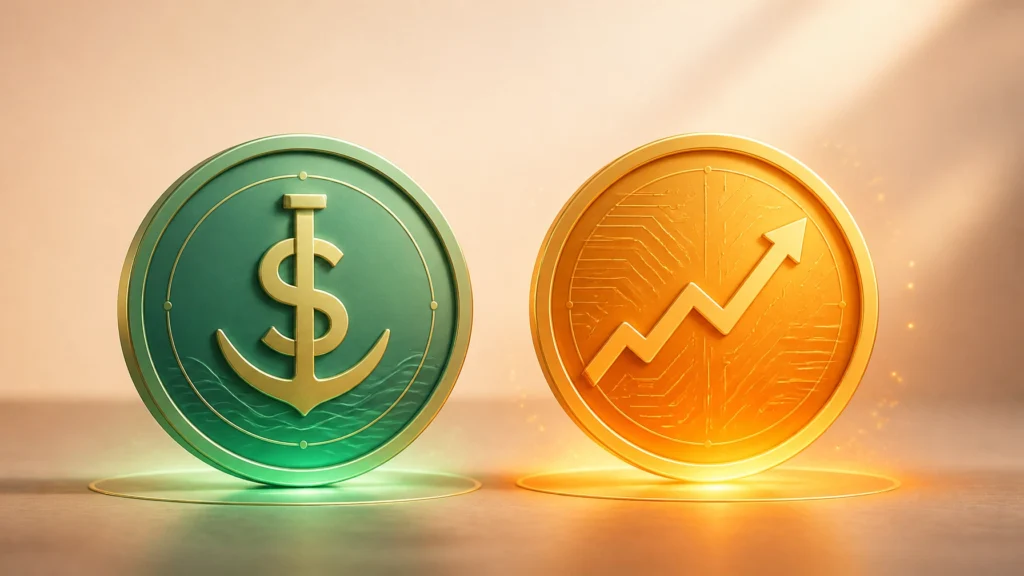
Early digital assets like Bitcoin were great, but their prices jumped up and down too much to be used as "everyday money." This is where stablecoins come in. Stablecoins are digital assets designed to stay at a steady value (usually $1.00 USD).
Imagine having the stability of the US Dollar, but with the freedom of "digital cash" that you can send to someone on the other side of the planet in seconds, without asking a bank for permission.

Be Your Own Bank with WeFi
At WeFi DeoBanking, we believe that the next evolution of money should belong to you.
The history of money shows a clear trend: we are constantly looking for ways to make money faster, more portable, and more accessible. But for too long, that progress has come at the cost of our independence.
We are here to provide the education and tools you need to navigate this new world. Our mission is to simplify complex financial technologies so that everyday people can learn how to manage, store, and move their money more efficiently. Whether you're an entrepreneur, a professional, or someone just looking for a smarter way to save, WeFi is your bridge to the future of finance.
The future of money isn't just digital: it's decentralized.
Are you ready to take control? Join our community and learn how to be your own bank.
Ready to learn more?
Check out our upcoming educational sessions or follow our journey on our YouTube channel to stay updated on the latest in stablecoins and digital finance.
Disclaimer: This content is for educational and informational purposes only and does not constitute financial, investment, or legal advice. Always do your own research before making financial decisions.