Stablecoins are a popular way to hold and move digital money without the big price swings people associate with crypto. If you’re learning digital finance for beginners, a stablecoin wallet is often one of the first tools you’ll hear about.
But here’s the part many people miss: choosing a wallet isn’t just picking an app. It’s deciding who controls your money, you, or a company.
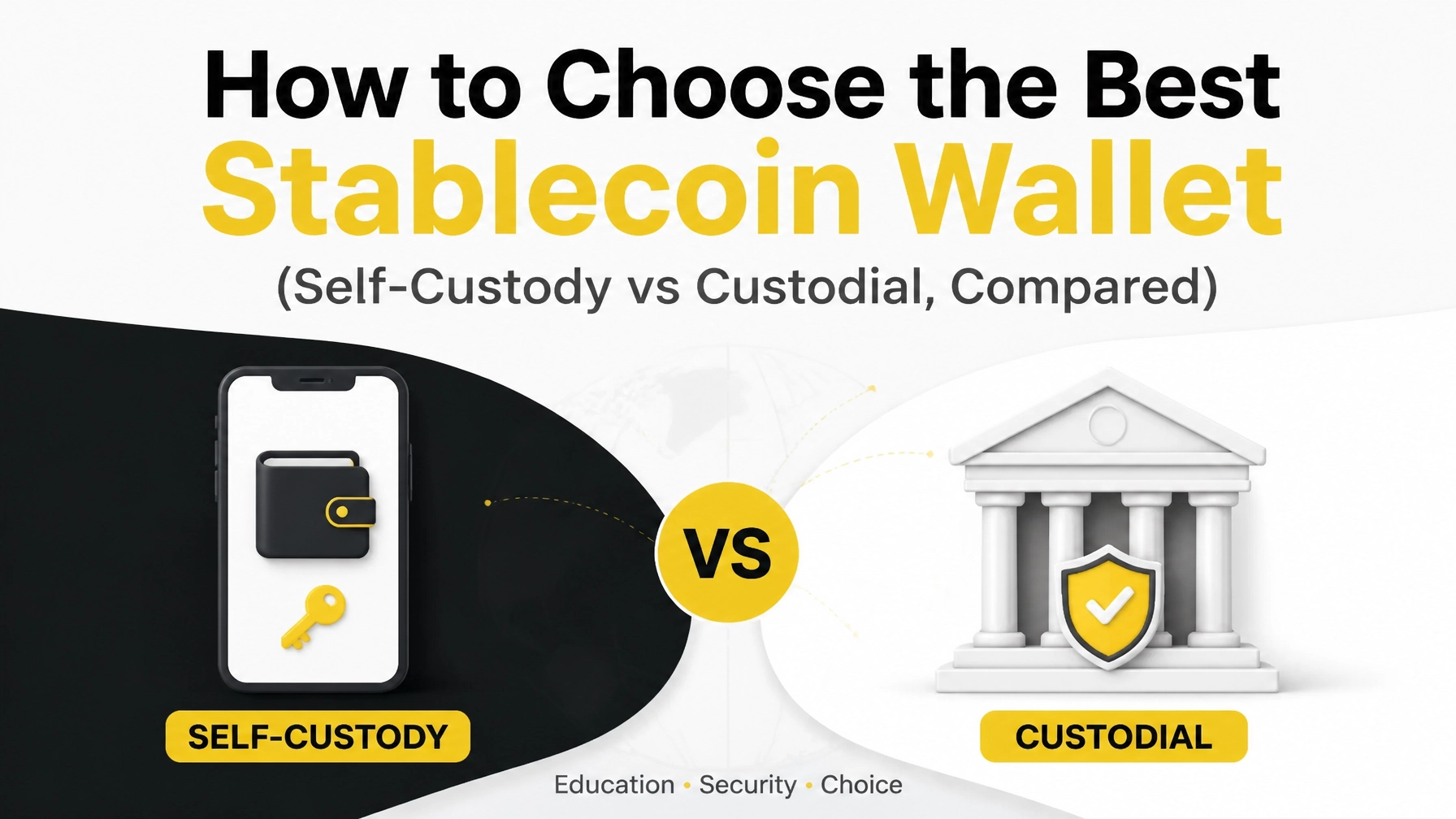
This guide breaks down self-custody vs custodial wallets in plain English, with a simple checklist, a pros/cons table, common mistakes, and an FAQ, so you can choose a setup that matches your comfort level and your goals around decentralized banking and personal control.
Important disclaimers (please read):
- This article is educational only and not financial advice.
- Digital assets (including stablecoins) involve risk, including the risk of losing access to funds.
- Stablecoins are not FDIC-insured (and may not have any government-backed insurance).
- WeFi DeoBanking is not a bank. We provide education and access to modern digital financial solutions.
First, what is a stablecoin wallet?
A “stablecoin wallet” is a wallet that can store, send, and receive stablecoins (digital tokens designed to maintain a more stable price, often by being linked to a currency like the U.S. dollar).
In everyday terms, a wallet helps with digital money management:
- checking your balance
- receiving stablecoins from someone else
- sending stablecoins to another wallet address
- (sometimes) swapping between tokens or networks
The big decision is whether you want:
- Self-custody (non-custodial): you control the wallet keys
- Custodial: a company controls the keys on your behalf
That one choice impacts privacy, recovery, and independence.
Self-custody vs custodial wallets: the simplest explanation
- Self-custody wallet: You hold the “keys” that control your stablecoins. If you want to move the funds, you can: without asking permission. This is the core idea behind decentralized finance basics: the user has direct control.
- Custodial wallet: a provider (like an exchange or app) holds the keys for you. You log in with an email/password, and they manage the behind-the-scenes wallet access.
A common phrase you’ll see in decentralized banking communities is: “If you don’t control the keys, you don’t fully control the funds.” That’s not meant to scare you: it’s simply describing how custody works.

Quick comparison table (control vs convenience)
| Feature | Self-custody wallet | Custodial wallet |
|---|---|---|
| Who controls access? | You (your keys) | Provider (their keys) |
| Recovery if you lose access | Seed phrase / backup you saved | Password reset + support (often with ID checks) |
| Independence | High (less reliance on a company) | Lower (account rules/limits may apply) |
| Ease for beginners | Medium (learning curve) | High (feels like a traditional finance app) |
| Best for | Long-term personal control, on-chain use, learning decentralized banking | Simple onboarding, quick start, familiar experience |
Stablecoin benefits (why people use them in the first place)
People explore stablecoins for practical reasons, such as:
- Faster transfers than some traditional methods (depending on network and provider)
- 24/7 movement of funds (no bank hours)
- Global accessibility (useful if you need cross-border flexibility)
- A stepping stone into decentralized banking ideas: having more direct control of your money’s movement
Reminder: stablecoins can still carry risks (issuer risk, platform risk, network risk, and regulatory changes). “Stable” does not mean “guaranteed.”
Checklist: how to choose the best stablecoin wallet for you
Use this as a decision checklist before downloading anything.

1) Decide your custody model (the big one)
Ask yourself:
- Do I want full control (self-custody), even if it means more responsibility?
- Or do I want convenience and recovery support (custodial), even if it means trusting a third party?
A practical approach many beginners use:
- Custodial for spending / learning
- Self-custody for stronger personal control once comfortable (especially for larger balances)
2) Confirm the wallet supports your stablecoin and your network
Stablecoins can exist on different networks. Before choosing a wallet, confirm:
- It supports the specific stablecoin you plan to use (example: USDC, USDT, DAI: verify inside the wallet’s official documentation).
- It supports the network you plan to use (example: Ethereum, Solana, Tron, etc.).
A common beginner issue is buying a stablecoin on one network, then trying to send it to an address/network that doesn’t match.
3) Check security features that actually matter
For self-custody:
- clear, guided backup process
- strong warnings against sharing your seed phrase
- optional hardware wallet support (helpful as you grow)
For custodial:
- strong login protection (2FA)
- clear withdrawal protections
- transparency about policies and limits
4) Understand recovery (before you need it)
- In self-custody, recovery usually means one thing: your seed phrase (a set of words that can restore your wallet). If you lose it and lose your device, you may lose access permanently.
- In custodial, recovery often means support + identity verification (which can be helpful: but also means the provider can restrict access based on policy or legal requirements).
5) Review fees and limits (small print, big impact)
- Custodial wallets may have: deposit/withdrawal fees, network choice fees, minimum withdrawals, or account limits.
- Self-custody wallets typically have no “account fee,” but you pay network transaction fees when sending.
6) Match the wallet to your goal (how to use stablecoins)
Different goals point to different setups:
- Learning decentralized finance basics / on-chain apps: usually self-custody
- Simple digital money management + beginner experience: custodial can be easier
- Cross-border transfers: either can work, but control and access matter: plan ahead
Pros and cons (plain English)
Self-custody wallets: pros
- You can be more independent from centralized banking systems and third-party policies
- You directly control sending/receiving (no “account approval” step)
- Often better aligned with the “be your own bank” mindset in decentralized banking
Self-custody wallets: cons
- You are responsible for backups and security
- Mistakes (wrong address, lost seed phrase, phishing) can be hard or impossible to undo
- It can feel confusing at first: and that’s normal
Custodial wallets: pros
- Easier for beginners (password login, app-like experience)
- Customer support and account recovery options
- Often simpler to convert between traditional money and stablecoins
Custodial wallets: cons
- You rely on a company’s security and decisions
- Your access can be limited (holds, freezes, withdrawal rules, region restrictions)
- Less privacy (often requires identity verification)

Common mistakes to avoid (these cause most wallet “horror stories”)
Most bad outcomes come from a few predictable mistakes: not from stablecoins themselves.

-
Saving your seed phrase in screenshots or cloud notes
If you use self-custody, treat your seed phrase like the master key to your money. Digital storage can be exposed through hacks, malware, or account takeovers. -
Sharing your seed phrase with “support”
Real wallet support will not need your seed phrase. Anyone asking for it is almost always trying to steal funds. -
Sending on the wrong network
“USDC” isn’t always “USDC” everywhere. The token name can be the same, but the network can differ. Always confirm network compatibility before sending. -
Not doing a small test transfer
When moving funds for the first time, consider sending a small amount to confirm the address and network work as expected. -
Keeping everything in one place
Many people split funds by purpose:
- a smaller “spending” balance (hot wallet or custodial)
- a more protected “hold” balance (self-custody with strong backup habits)
FAQ (beginner-friendly)
Are stablecoins risk-free?
No. Stablecoins can carry risks such as issuer risk, platform risk, network risk, de-pegging events, and regulatory changes. “Stable” typically describes an intended design, not a guarantee.
Are stablecoins FDIC-insured?
Generally, no. Stablecoins are usually not FDIC-insured, and protections vary by provider and region. Always read the stablecoin and platform disclosures.
Is self-custody “better” than custodial?
Not universally. Self-custody is better for personal control and independence: but it also requires more responsibility. Custodial is often better for simplicity and recovery, but requires trust in a third party.
What’s the easiest way to start learning how to use stablecoins?
Start with education, then practice carefully:
- learn the basics (wallet types, networks, addresses)
- set up one wallet
- start small
- double-check everything before sending
This learning-first approach prevents most painful mistakes.
Can a stablecoin be frozen?
It depends. Custodial accounts can be restricted by the provider. Separately, some stablecoins have issuer-level controls written into their token contracts. This is one reason it’s smart to learn the basics before relying on any single option.
Final pick: which wallet type should you choose?
If your priority is being your own bank and reducing dependence on centralized systems, self-custody is usually the direction to learn: slowly and safely.
If your priority is simple setup and account recovery, a custodial wallet can be a reasonable starting point: especially for beginners: as long as you understand the trade-offs.
Either way, the “best” stablecoin wallet is the one you can use confidently, with security habits you will actually follow.
Soft next step (no pressure): learn with WeFi DeoBanking
If you want help making sense of wallets, stablecoins, and decentralized banking in plain English, explore WeFi DeoBanking’s education resources and beginner guides:
- https://wefideobanking.com/
- https://wefideobanking.com/category/uncategorized/ (current blog category page)
We’re here to help you build real skills in modern digital money management: so you can make informed choices and keep more control in your own hands.