For a long time, if you wanted to manage your money, you had one choice: a traditional bank. You’d walk into a brick-and-mortar building, wait in line, and hope the person behind the glass was having a good day.
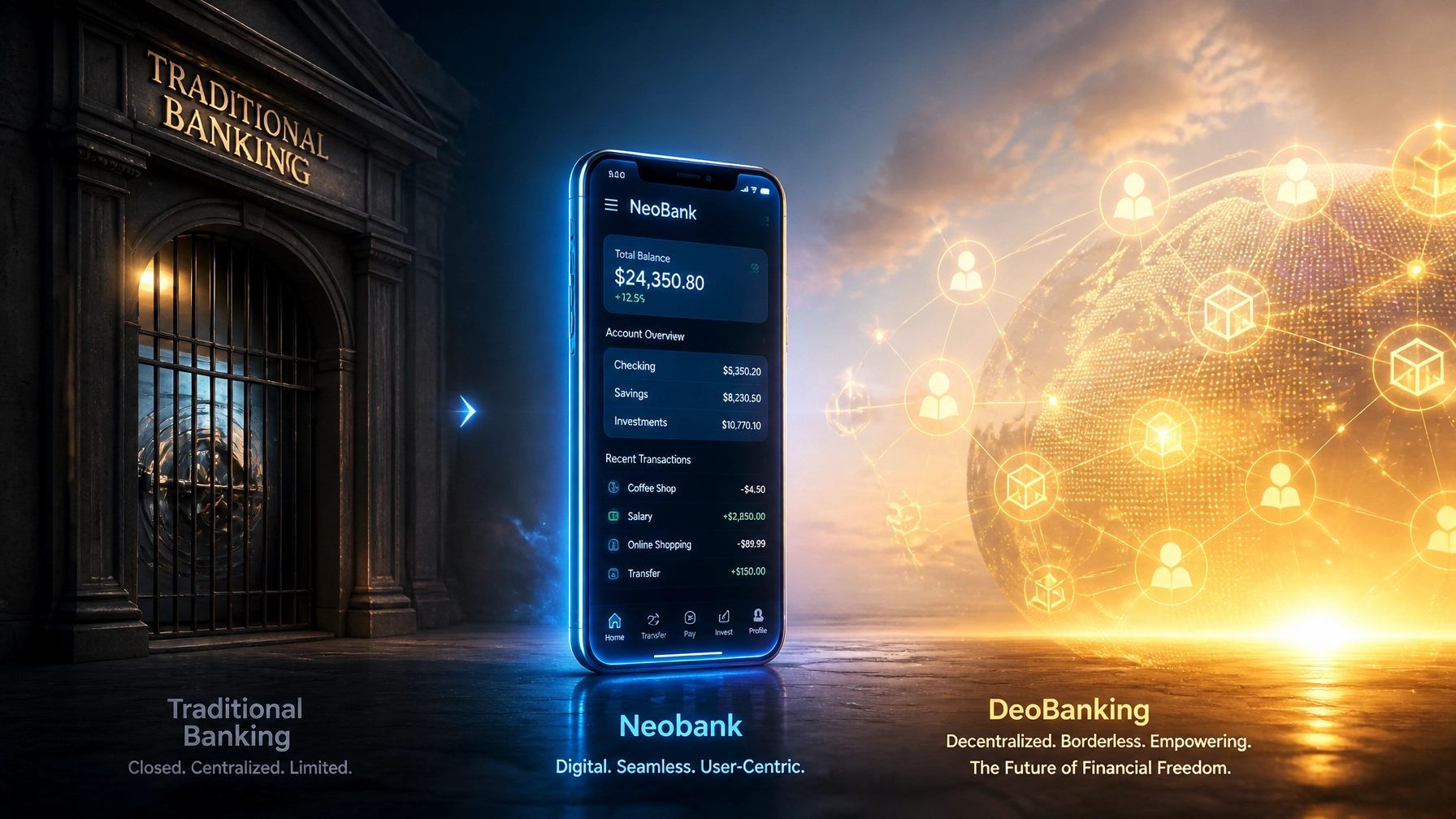
Then came the Neobanks. Apps like Chime, Revolut, and Monzo changed everything. They took the bank out of the building and put it into your pocket. Suddenly, you could open an account in minutes, get instant notifications, and avoid those pesky monthly maintenance fees. It felt like the future.
But as the digital world evolves, many are starting to realize that Neobanks were just a "digital facelift" for an old system. While the app looks beautiful, the pipes underneath: the centralization, the government control, and the "we can freeze your account anytime" fine print: remain the same.
Enter DeoBanking (Decentralized Banking). This isn’t just a better app; it’s a whole new infrastructure. It’s about moving beyond "modern" apps and toward true financial independence.
In this post, we’re going to break down why the world is shifting from Neobanks to DeoBanking and how you can start taking control of your own assets.
What exactly is a Neobank? (The Convenience Phase)
Neobanks are digital-only platforms that offer banking services via a mobile app. They don’t have physical branches, which saves them a lot of money: savings they often pass on to you through lower fees.
The Good:
- User Experience: Their apps are usually light-years ahead of traditional banks.
- Speed: You can sign up during your lunch break.
- Features: They offer cool tools like automatic budgeting and early direct deposits.
The Not-So-Good:
At the end of the day, a Neobank is still a bank (or a company partnered with one). They are centralized. This means they have the final say over your money. If they decide your activity is "suspicious," or if a government agency sends them a notice, your funds can be frozen instantly. You are a customer, not an owner.
What is DeoBanking? (The Freedom Phase)
DeoBanking, or Decentralized Banking, is what happens when you combine the slick user experience of a Neobank with the power of blockchain technology.
At WeFi, we see DeoBanking as the next logical step in the evolution of money. Instead of your money sitting in a centralized database owned by a corporation, your assets live on a transparent, decentralized ledger (a blockchain).

When you use a DeoBanking system, you are moving toward self-custody. You hold the keys. You are the one who authorizes transactions. There is no middleman sitting between you and your wealth. This is the heart of the "Be Your Own Bank" movement.
Neobank vs. DeoBanking: The Main Event
To help you see the difference, let’s look at the core pillars of how these two systems operate.
| Feature | Neobank | DeoBanking (DeFi) |
|---|---|---|
| Control | The bank controls your account. | You control your assets via your keys. |
| Transparency | Closed, private ledgers. | Open, public blockchain ledgers. |
| Access | Subject to credit checks and local laws. | Global access; anyone with internet can join. |
| Availability | Subject to banking hours for settlement. | 24/7/365 instant global settlement. |
| Philosophy | "We make banking easier." | "You are the bank." |
1. Control and Sovereignty
In a Neobank, your money is technically an IOU from the bank. In DeoBanking, your money (often held in stablecoins like USDC or USDT) is a digital asset that you physically control. This independence from centralized banking systems and government control is the primary reason people are making the switch.
2. Transparency and Trust
Have you ever tried to track exactly where your bank "puts" your money once you deposit it? It’s nearly impossible. With DeoBanking, every transaction and every "smart contract" (the digital rules that manage the money) is visible on the blockchain. You don't have to trust a bank’s word; you can verify the code.

Why Modern Finance is Moving Beyond Traditional Apps
Why are people leaving the "safety" of traditional apps for DeoBanking? It comes down to Financial Freedom.
Global Asset Control
We live in a global economy, but traditional banks are still stuck behind national borders. If you want to send money to a friend in another country via a Neobank, it might still take days to "settle" and cost a chunk in fees.
In the world of DeoBanking, sending money to someone across the street is the same as sending it to someone across the ocean. It’s instant, it’s cheap, and it doesn't require a bank's permission.
Independence from Centralized Failures
We’ve all seen the headlines about banks failing or ATMs going offline. When you rely on a centralized app, you are at the mercy of their uptime and their solvency. DeoBanking protocols are distributed across thousands of computers globally. There is no "off" switch.
Educational-First Approach
At WeFi, we believe that the biggest hurdle to DeoBanking isn't the technology: it's education. This is why we focus so heavily on helping individuals understand the "how" and "why" of stablecoins and decentralized systems.

Is DeoBanking Right for You? (A Quick Checklist)
If you're wondering if it's time to move beyond your current banking app, ask yourself these questions:
- Do I want to have 100% control over when and where I move my money?
- Am I tired of waiting for "business days" for my transactions to clear?
- Do I want to learn how to use stablecoins to protect my purchasing power?
- Am I interested in a financial system that operates 24/7?
- Do I value transparency over corporate secrecy?
If you checked more than three boxes, it's time to start your journey into decentralized finance.
Frequently Asked Questions (FAQ)
Is DeoBanking the same as regular Crypto?
Not exactly. While DeoBanking uses blockchain technology (the same tech as Bitcoin), it often focuses on stablecoins. These are digital assets pegged 1-to-1 with a stable currency like the US Dollar. This gives you the speed of crypto without the wild price swings.
Is my money insured by the FDIC?
No. This is a very important distinction. Neobanks usually have FDIC insurance because they partner with traditional banks. DeoBanking platforms, like WeFi, are not banks. Because you are in control of your own assets, they are not covered by government insurance schemes. You trade that safety net for absolute control and independence.
Can a DeoBank freeze my account?
In a truly decentralized system, there is no central "button" to freeze an account. However, different platforms have different levels of decentralization. This is why education is key: you should always understand who holds the "keys" to your digital wallet.
Important Disclaimers
Before you take the leap, let's keep it real:
- Educational Purposes Only: This blog post is for educational and informational purposes. It is not financial advice. Always do your own research.
- WeFi is Not a Bank: WeFi provides access to modern digital financial solutions and education. We are not a bank, and we do not offer FDIC insurance.
- Risk Disclosure: Digital assets carry inherent risks, including market volatility and technical risks. Never put in more than you are willing to learn with.
- No Guarantees: There are no guarantees of earnings or "wealth building." Our goal is to empower you with tools, not promises.
Ready to Learn More?
The shift from Neobanks to DeoBanking is about more than just a faster app: it's about a fairer, more open financial system for everyone. At WeFi, we’re here to help you navigate this new world.

If you're ready to stop being just a "customer" and start being your own bank, join our community. We host regular educational sessions to help you understand the power of stablecoins and decentralized systems.
Visit WeFi.co today to start your educational journey!