If you’ve ever tried to send money to a friend in another country on a Friday afternoon, you know the "Banking Weekend" struggle. You hit "send," and then… you wait. Saturday passes. Sunday passes. By Tuesday, your money might finally show up, minus a chunk of "intermediary fees" that nobody seems able to explain.
In a world where we can stream movies instantly and chat with someone halfway across the globe in real-time, why does our money still move at the speed of a 19th-century pony express?
The truth is, the way we handle our cash is changing. You might have heard terms like stablecoins and digital money management popping up in conversations. But what do they actually mean for you? Is it time to ditch the traditional bank teller for a digital wallet?
Let’s break down the stablecoin vs traditional banking showdown and see which one actually wins for your daily life.
What Exactly is a Stablecoin? (The 60-Second Explanation)
Think of a stablecoin as the "middle ground" between traditional cash and the fast-paced world of digital assets.
Traditional cryptocurrencies, like Bitcoin, can be like a roller coaster, up 10% today, down 15% tomorrow. That’s great for speculators, but not great if you’re trying to pay your rent or buy groceries.
A stablecoin is a digital token designed to stay "stable." Usually, it’s pegged 1:1 to a real-world currency, like the US Dollar. So, 1 stablecoin = $1 USD. You get the speed and global reach of digital technology without the "heart attack" volatility.
At WeFi DeoBanking, we focus on helping you understand how these tools work so you can stop being a spectator and start taking control.
Round 1: Speed , Settlement in Seconds vs. Days

The biggest difference between these two systems is the "plumbing" underneath.
Traditional Banking: The "Wait and See" Approach
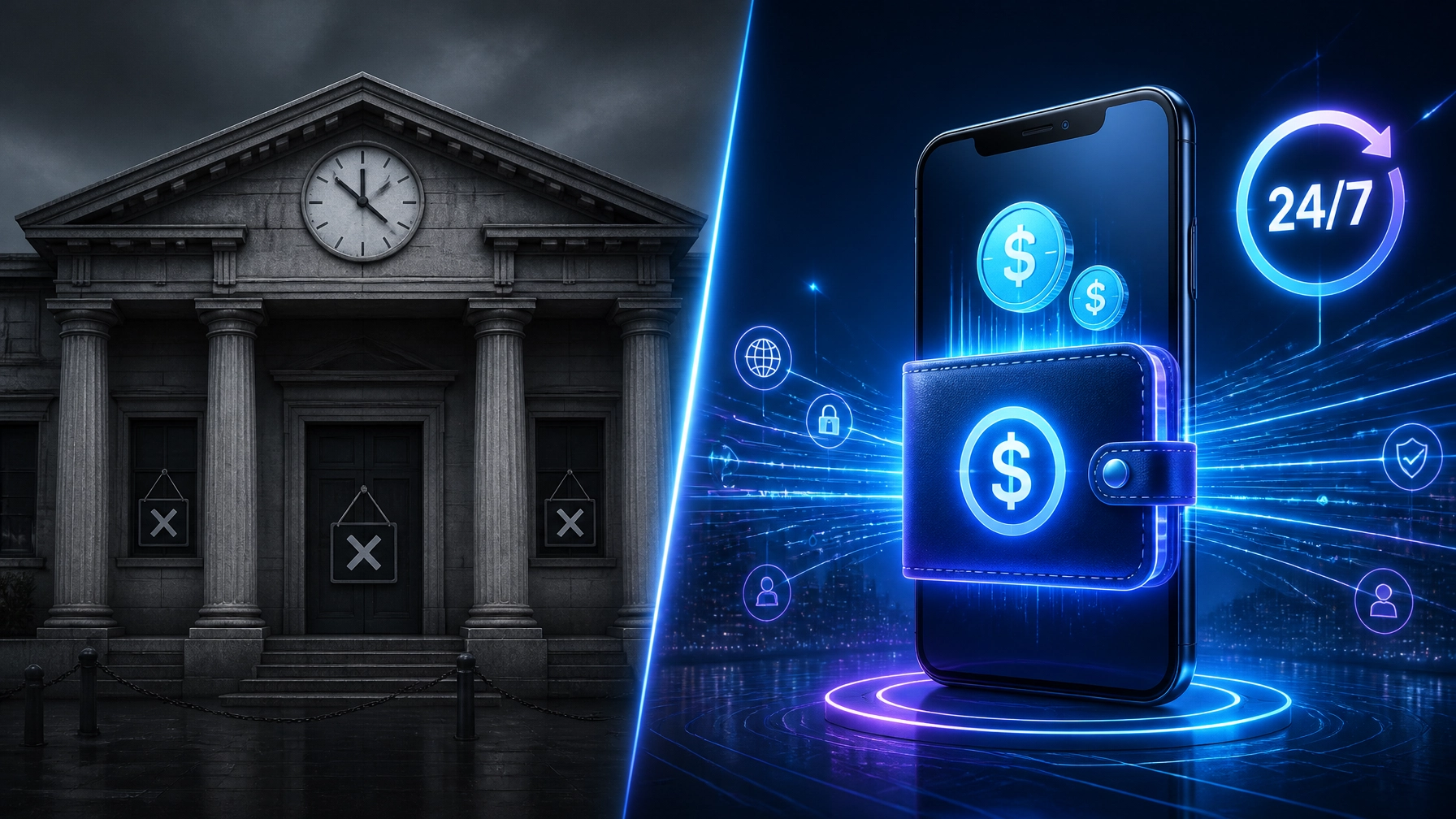
When you move money through a bank, it doesn't actually "move" instantly. Instead, a series of banks send messages to each other saying, "I owe you this much." This process, known as settlement, often takes 1 to 5 business days, especially for international transfers. Plus, banks have "closing hours." If you miss the 3 PM cutoff on a Friday, your money is essentially stuck in limbo until Monday morning.
Stablecoins: The 24/7/365 Reality
Stablecoins run on blockchain networks that never sleep. Whether it's 2 AM on a Sunday or Christmas Day, the network is open. A stablecoin transfer usually settles in seconds to minutes. You send it, they get it, and it’s ready to use. No "pending" status, no waiting for the bank to open, and no excuses.
The Verdict: If speed is your priority, stablecoins win by a landslide.
Round 2: Accessibility , Who’s Allowed in the Club?
Traditional banking is often built on "permission." To get a bank account, you need a specific set of documents, a local address, and sometimes a minimum balance. Globally, billions of people are "unbanked" simply because they don't meet these rigid criteria.
Stablecoins change the math. All you need is:
- A smartphone.
- An internet connection.
- A digital wallet app.
This is the core of digital money management. It levels the playing field. Whether you are an entrepreneur in Lagos or a freelancer in London, you have access to the same financial "rails." At WeFi, we believe that everyone deserves the right to move and store their value without jumping through unnecessary hoops.
Round 3: The Cost of Doing Business (Hidden Fees)

Have you ever looked at your bank statement and seen a "Service Fee" or an "Out-of-Network ATM Fee" and thought, Why am I paying them to hold my money?
Traditional banks have massive overhead. They have physical buildings, thousands of employees, and legacy software systems from the 1980s. You pay for that overhead through fees and low-interest rates on your savings.
Stablecoin transactions remove the middleman. When you send money wallet-to-wallet, you aren't paying for a CEO's corner office; you're just paying a small "gas fee" to the network to process the transaction. For international moves, this can be up to 80% cheaper than traditional wire transfers or remittance services.
Round 4: Control : Being Your Own Bank
This is where the "DeoBanking" philosophy really kicks in.
In a traditional bank, the bank technically "controls" your access. They can freeze your account, limit how much you can withdraw, or decline a transaction they deem "unusual."
When you use stablecoins and manage your own digital assets, you are the bank. You have global asset control. Your money stays in your wallet, and you are the only one with the "keys."
While this freedom comes with the responsibility of keeping your keys safe (which is exactly what we teach in our educational sessions), it also means you are no longer at the mercy of centralized systems that might not have your best interests at heart.
Is Traditional Banking Still Useful?
Let’s be real: we aren’t saying banks are going to disappear tomorrow. Traditional banking still has its place, especially for things like:
- Regulation & Protection: Banks offer deposit insurance in many countries.
- Complex Loans: Getting a mortgage for a house is still a very "traditional bank" activity.
- Dispute Resolution: If you make a mistake on a bank transfer, you can sometimes call them to fix it. With blockchain, once it’s sent, it’s sent.
However, for moving money, storing value, and participating in the global economy, the stablecoin benefits are becoming too big to ignore.
Bridging the Gap with WeFi
The world of digital finance can feel like a lot to take in. That’s why WeFi exists. We aren't here to give you complex jargon; we’re here to give you the map.

We host regular, live Zoom sessions to help you navigate this transition. We talk about:
- How to set up your first digital wallet safely.
- The difference between various stablecoins.
- How to protect your assets from scams.
- Practical ways to use these tools in your everyday life.
Our goal is to make these "complex" technologies simple so that you can move your money more efficiently in today’s digital economy.
The Final Verdict: Which Is Better?
Stablecoin vs traditional banking isn't necessarily an "either/or" choice for most people right now: it’s about having the right tool for the job.
If you want to pay your local taxes or get a mortgage, stick with your bank. But if you want to:
- Send money across borders instantly.
- Avoid high intermediary fees.
- Have 24/7 access to your funds.
- Take control of your own financial future.
…then stablecoins are the clear winner.

The financial system is evolving. The question is, will you evolve with it, or will you stay stuck waiting for the bank to open on Monday morning?
Ready to take the next step?
Don't let the technology intimidate you. Join one of our free educational sessions and learn how to "be your own bank" with confidence.
Click here to explore our resources and join our next session at BridgeToWeb3.com